





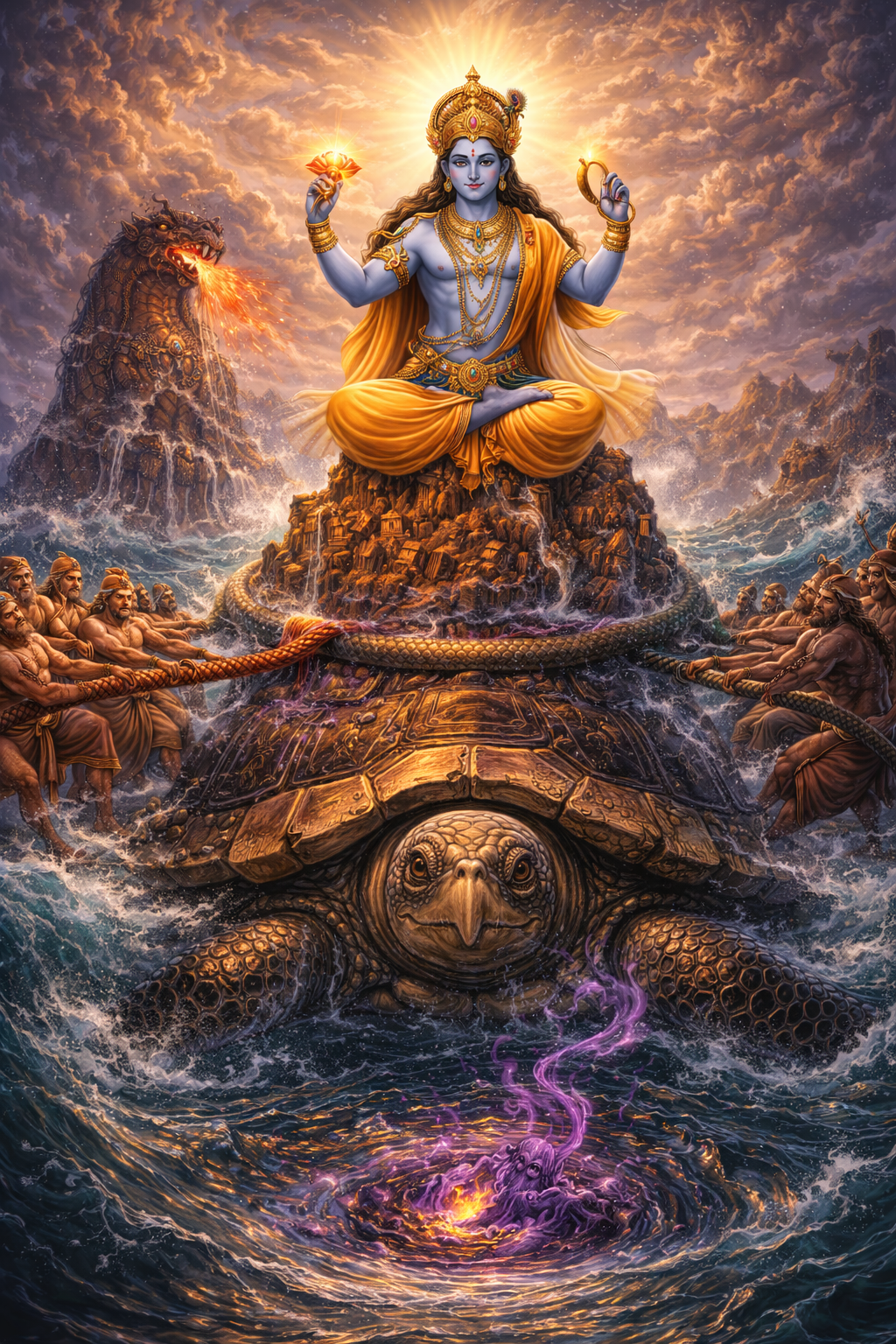
Kūrma Avatāra – The Divine Foundation of Stability
The Avatāra Who Became the Support When the World Needed Balance
Kurma is the second avatāra of Vishnu, appearing after the preservation of knowledge through Matsya. Where Matsya saved wisdom from destruction, Kūrma provided stability so creation could progress further.
After the stability of Kurma, the next incarnation is Varaha Avatara.
In Sanatana Dharma, Kurma represents support, patience, and silent strength—the unseen foundation without which great efforts collapse.
The Condition of the World at the Time
After the cosmic flood and restoration of knowledge, the Devas (celestial beings) and Asuras (forces of ambition) sought Amṛta, the nectar of immortality, to regain strength and balance in the universe.
However, the task required immense cooperation and effort. The churning of the cosmic ocean—Samudra Manthana—was beyond the strength of either side alone. Without a stable base, the entire process failed repeatedly.
Dharma now needed support, not destruction or rescue.
The Need for Divine Intervention
To churn the ocean, Mount Mandara was chosen as the churning rod. But as soon as the process began, the mountain sank into the ocean depths, unable to withstand the pressure.
At this critical moment, Vishnu incarnated as Kūrma, the divine tortoise, and placed the mountain upon his back—becoming the immovable foundation that allowed the cosmic process to continue.
👉 Kūrma did not lead, fight, or command—he supported silently.
The Role of Kūrma in Samudra Manthana
With Kūrma as the base:
The Devas and Asuras used Vāsuki, the serpent king, as the churning rope
The ocean was churned steadily and rhythmically
Both blessings and dangers emerged, including:
Poison (Hālāhala)
Celestial beings and treasures
Goddess Lakṣmī
Finally, Amṛuta, the nectar of immortality
Without Kūrma’s support, none of these outcomes—good or bad—could have manifested.
Symbolism of the Kūrma Avatāra
Kūrma carries profound symbolic meaning:
Tortoise – Stability, endurance, patience
Hard shell – Inner strength and protection
Silent support – Selfless service without recognition
Foundation beneath movement – Stillness enabling progress
Kūrma also reflects yogic symbolism—just as a tortoise withdraws its limbs inward, inner steadiness allows outer action to succeed.
Spiritual and Modern Relevance
Kūrma teaches lessons especially relevant in modern life:
Progress requires patience and grounding
Great achievements depend on unseen support
Not all contributions are visible—but they are essential
Stability must come before expansion
In families, organizations, and societies, the “Kūrma role” is often played by those who support without applause.
Simple Takeaway
Before growth, there must be stability.
Kūrma Avatāra teaches that silent support is the backbone of lasting success.
🪔 Key Lessons from Kūrma Avatāra
Stability is essential for progress
True strength often works silently
Support roles are as important as leadership
Patience sustains long-term effort
Stillness enables meaningful action
🔍 Short Summary
The Kūrma Avatāra represents the quiet yet powerful force of support in the cosmic order. By bearing Mount Mandara during the churning of the ocean, Lord Vishnu ensured that cooperation, effort, and transformation could take place. Kūrma teaches that without stability and patience, even the greatest goals cannot be achieved.


