




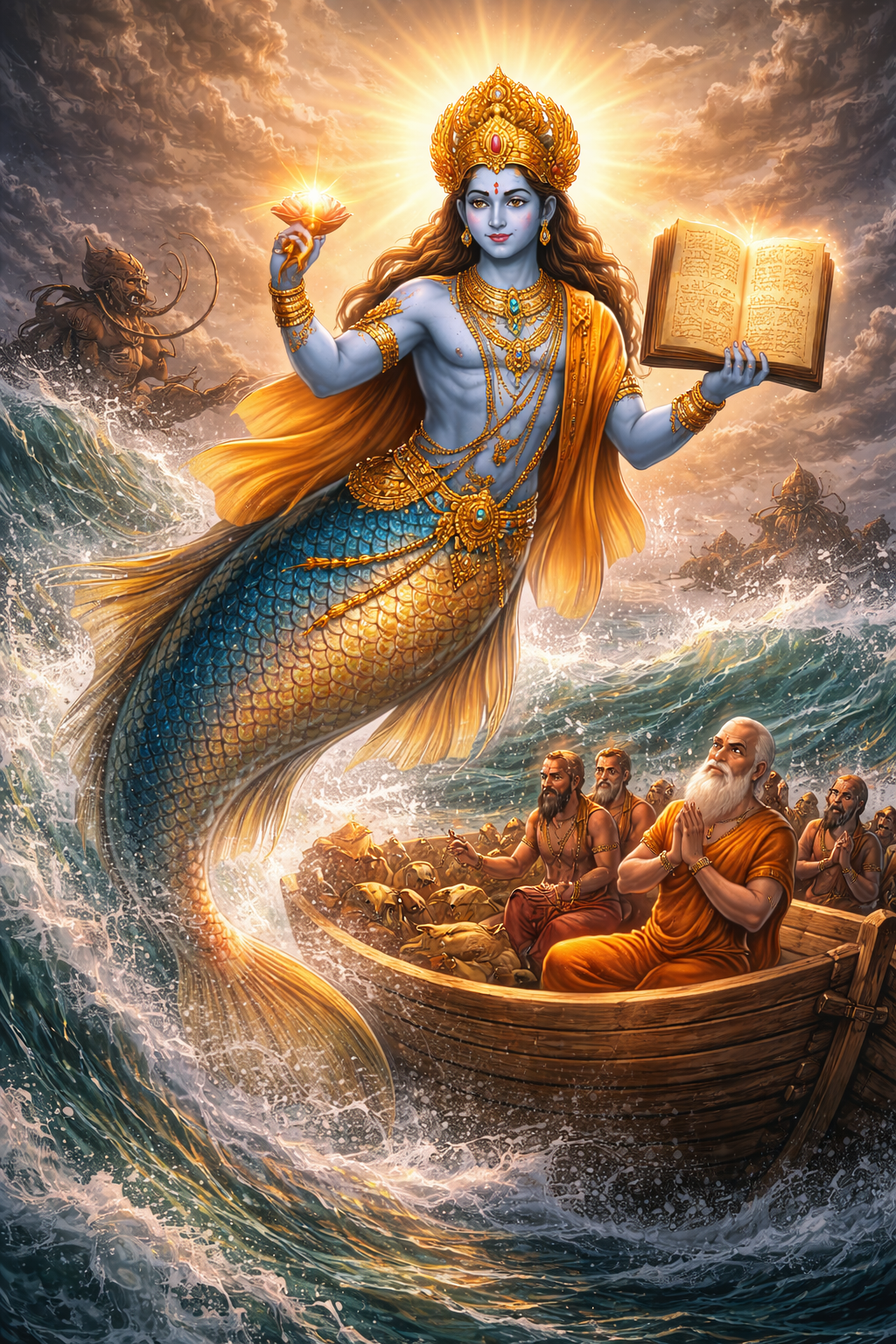
Matsya Avatāra – The Divine Protector of Knowledge
The First Avatāra Who Preserved Dharma at the Dawn of Creation
Matsya is the first avatāra of Vishnu, appearing at the threshold of a new cosmic cycle. In Sanātana Dharma, Matsya represents the safeguarding of wisdom, life, and continuity when existence itself faces dissolution.
This avatāra establishes a core principle that echoes through all later incarnations:
Dharma cannot survive without the preservation of knowledge.
The Condition of the World at the Time
At the end of a great age, the universe approached Pralaya—a cosmic dissolution marked by a vast flood. This deluge threatened to erase the Vedas, the seeds of life, and the lineage of sages and humanity. Without sacred knowledge, the next creation would arise without order or moral direction.
The Appearance of Matsya
Matsya appeared to Manu, the first lawgiver of humanity, as a small fish seeking protection. As Manu compassionately cared for it, the fish grew beyond all limits, revealing its divine nature—teaching that the divine often tests responsibility before revealing truth.
The Divine Warning and the Great Boat
Matsya warned Manu of the coming flood and instructed him to prepare:
A strong boat
The Saptarishis (seven sages)
Seeds of all living beings
Sacred texts and wisdom
When the flood arrived, the boat was tied to Matsya’s horn and guided safely through the waters—symbolizing human effort aligned with divine guidance.
The Rescue of the Vedas
During the deluge, the demon Hayagriva stole the Vedas and hid them in the cosmic ocean. Matsya descended, defeated the demon, and restored the Vedas—ensuring that knowledge guided the rebirth of creation.
Symbolism of the Matsya Avatāra
Fish – Life emerging from water; adaptability and survival
Flood – Cycles of destruction and renewal
Boat – Preparation and disciplined action
Horn of Matsya – Divine guidance steering human effort
Saved Vedas – Knowledge as the soul of Dharma
Matsya also hints at evolutionary progression, with life beginning in water before moving toward stability on land in later avatāras.
Spiritual and Modern Relevance
Matsya reminds us to protect truth and learning during times of chaos, confusion, or misinformation. When values are threatened, wisdom must be preserved first so society can rebuild with clarity and purpose.
Simple Takeaway
Before rebuilding the world, Dharma ensures that wisdom survives.
Matsya teaches that knowledge is the first refuge in times of chaos.
🪔 Key Lessons from Matsya Avatāra
Knowledge is the foundation of Dharma
Divine guidance often appears quietly at first
Compassion and responsibility invite higher truth
Crisis leads to renewal when wisdom is preserved
Human effort must align with divine order
🔍 Short Summary
The Matsya Avatāra marks the beginning of divine intervention in creation. By saving Manu, the sages, and the Vedas during the great flood, Lord Vishnu ensured that knowledge, life, and Dharma survived cosmic destruction. Matsya teaches that when everything else is lost, wisdom must be preserved first—for it alone can guide renewal and righteous living.
From the first protection in the Matsya Avatara to the final restoration in the Kalki Avatara, the Dashavatara represents the complete cycle of time.
Next in the Dashavatara is the Kurma Avatara…


