



Rāma Avatāra (Seventh Avatāra) – The Ideal King and Upholder of Dharma
The Avatāra Who Lived Dharma as a Human Ideal
Rama is the seventh avatāra of Vishnu in the Daśāvatāra.
After Parashurāma (6th Avatāra) corrected the misuse of power through righteous force, Dharma now required a living example—not correction alone, but conduct.
Rāma represents Dharma lived fully in human life—as a son, husband, brother, warrior, and king.
The Condition of the World at the Time
The world was troubled by the tyranny of Ravana, whose power and intellect were immense, but whose arrogance and desire led him away from Dharma. Despite knowledge and devotion, Ravana chose ego over righteousness.
Adharma now manifested not only as power—but as moral failure.
Birth and Divine Purpose
Rāma was born in Ayodhyā to King Dasharatha and Queen Kaushalya, appearing as a prince among humans.
His mission was unique:
Not to display divinity openly
Not to bypass suffering
But to live within human limits and still uphold Dharma perfectly
Life of Sacrifice and Duty
Rāma’s life is marked by conscious choices rooted in Dharma:
Accepting exile to honor his father’s word
Walking into the forest without resentment
Standing by his wife Sita through hardship
Upholding justice even when it demanded personal pain
He chose duty over comfort, again and again.
The Battle Against Ravana
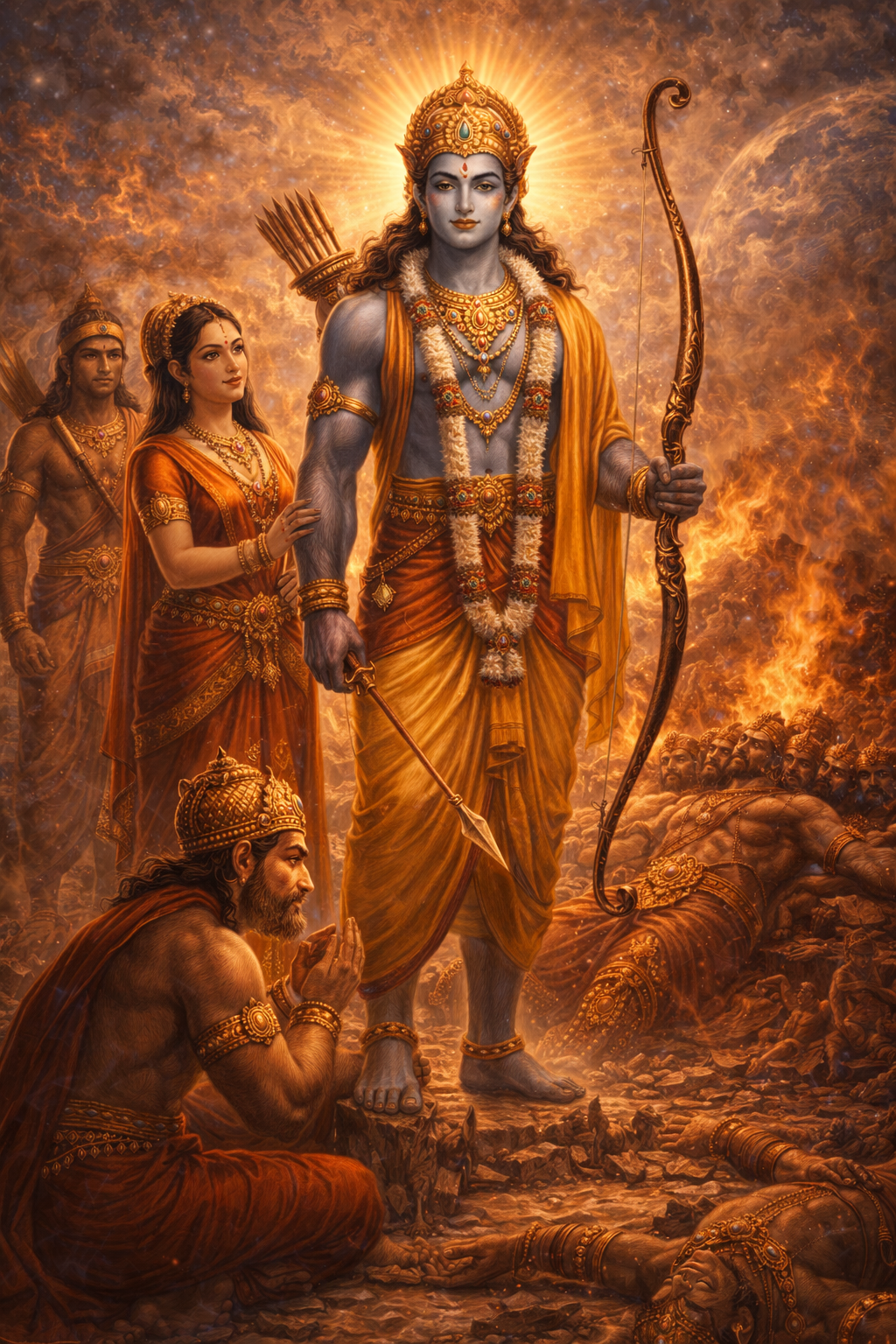
The abduction of Sītā by Ravana was not merely personal—it symbolized the violation of righteousness. With the help of:
Lakshmana
Hanuman
The Vānara army
Rāma confronted Ravana and ultimately defeated him—not in anger, but as an act of justice.
Rāma Rājya – Rule of Dharma
After returning to Ayodhyā, Rāma established Rāma Rājya—a reign defined by:
Justice and fairness
Welfare of all beings
Moral clarity
Accountability of the ruler
It represents the ideal society governed by Dharma, not fear.
Symbolism of the Rāma Avatāra
Bow (Kōdaṇḍa) – Responsibility and moral strength
Exile – Acceptance of hardship for righteousness
Victory over Ravana – Triumph of values over ego
Rāma Rājya – Dharma in governance
Rāma shows that Dharma is not abstract—it is lived choice by choice.
Spiritual and Modern Relevance
Rāma Avatāra speaks directly to daily life:
Leadership means service, not privilege
Personal sacrifice can uphold collective good
Integrity must be preserved even under pressure
In a complex world, Rāma offers a clear compass: Do what is right, even when it is difficult.
Simple Takeaway
Rāma Avatāra teaches that Dharma is not preached—it is practiced.
True greatness lies in choosing righteousness within human limits.
🪔 Key Lessons from Rāma Avatāra (7th Avatāra)
Dharma is lived through action, not intention alone
Duty may demand personal sacrifice
Leadership requires moral courage
Justice must be firm yet compassionate
An ideal society begins with an ideal ruler
🔍 Short Summary
The Rāma Avatāra (Seventh Avatāra of Vishnu) presents Dharma embodied in human life. Through sacrifice, discipline, and unwavering commitment to righteousness, Rāma showed that divine ideals can be lived within human boundaries. His life teaches that Dharma is strongest when it is chosen freely, even at great personal cost.
After the human example of Lord Rama, the divine play continued with the wisdom of Krishna Avatara.
While Lord Rama established external Dharma as a king, the later Buddha Avatara focused on the inner Dharma of the mind.