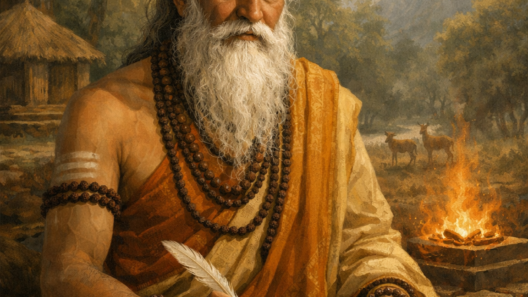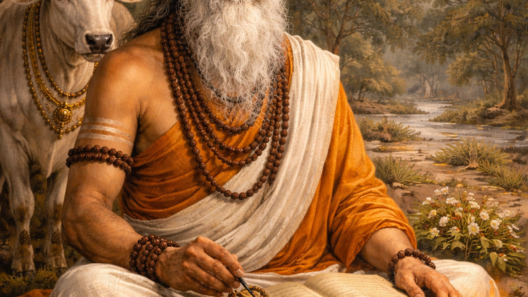



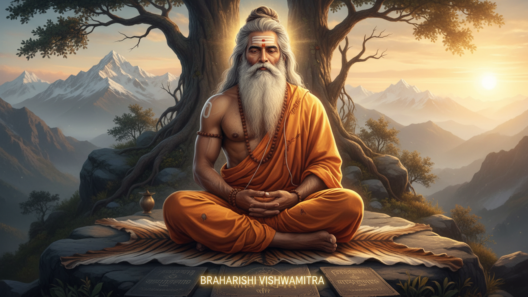




Maharishi Atri is revered as a Brahmarishi whose life and wisdom represent clarity beyond conflict, awareness beyond fluctuation, and illumination beyond darkness. Among the great sages of Sanatana Dharma, Atri stands as the embodiment of equanimity—a consciousness untouched by pleasure and pain, success and failure, creation and dissolution.
If Maharishi Bharadvaja represents applied knowledge and Maharishi Vashistha represents effortless realization, Maharishi Atri represents luminous balance—the silent witnessing awareness that remains unchanged amid all movement.
The Spiritual Role of Maharishi Atri
Maharishi Atri occupies a deeply subtle yet foundational role in Sanatana Dharma:
He represents inner vision rather than external authority
He embodies mastery over mental fluctuations
He stabilizes consciousness beyond emotional extremes
He preserves balance within cosmic order
Through Atri, Sanatana Dharma teaches that true power lies in inner stillness, not outward dominance.
Meaning and Inner Significance of the Name “Atri”
The name Atri carries profound philosophical meaning.
Traditionally, it is interpreted as:
“One who is beyond the three”
One who transcends the three gunas
One who is untouched by duality
The “three” refer to Sattva (harmony), Rajas (activity), and Tamas (inertia)—the fundamental forces governing the material world.
Atri represents Turiya, the state of awareness beyond these three forces.
Maharishi Atri as a Mind-Born Son of Brahma
According to ancient tradition, Maharishi Atri is a Manasaputra (mind-born son) of Brahma.
Unlike sages who gained wisdom through long accumulation, Atri’s knowledge arises from:
Pure consciousness
Direct insight
Innate awareness
This establishes him as a rishi whose wisdom is intrinsic rather than acquired, flowing directly from the source of creation.
Atri in the Rig Veda and Early Vedic Thought
Maharishi Atri is among the earliest contributors to the Rig Veda, particularly associated with the Fifth Mandala.
His hymns reveal:
Deep contemplation of cosmic order
Reverence for solar and luminous principles
Insight into the relationship between mind and universe
Atri’s Vedic vision emphasizes that illumination is both cosmic and internal.
Marriage to Anasuya: The Ideal of Purity and Balance
Maharishi Atri was married to Anasuya, one of the most revered women in Sanatana Dharma.
Anasuya represents:
Absolute purity of intention
Freedom from envy and ego
Devotion balanced with wisdom
Their union symbolizes the perfect harmony between awareness and virtue, making their household a living expression of Dharma.
The Birth of Divine Lineages
One of the most extraordinary aspects of Maharishi Atri’s legacy is his role in giving rise to multiple divine lineages.
Through the combined tapas of Atri and Anasuya, manifestations associated with:
Preservation
Transformation
Creation
arose within their family tradition.
This symbolizes a deeper truth:
When awareness and purity unite, cosmic forces naturally align.
Atri and the Lunar Lineage
Maharishi Atri is also associated with the Lunar tradition, linking him to kings, sages, and divine figures who emphasized:
Emotional intelligence
Inner reflection
Adaptability
This lineage later becomes central to the spiritual narrative of Sanatana Dharma, balancing the Solar emphasis on order and authority.
Spiritual Significance: Mastery Beyond the Gunas
Atri’s greatest teaching is not ritual or law—it is transcendence.
He teaches that:
Sattva refines but still binds
Rajas energizes but agitates
Tamas stabilizes but obscures
Freedom lies beyond all three.
This insight is foundational to meditation, yoga, and self-realization traditions.
Atri as the Sage of Equanimity
Maharishi Atri embodies Samatva—inner equality.
He demonstrates that:
Peace does not depend on circumstances
Awareness remains unchanged amid change
True clarity is non-reactive
This makes Atri especially relevant for modern seekers navigating emotional and mental turbulence.
Maharishi Atri and Natural Meditation
In the context of Natural Meditation, Atri represents pure witnessing awareness.
The Atri Practice (Witnessing Without Engagement)
When the mind feels pulled by emotion:
Sit quietly and breathe naturally
Allow thoughts and feelings to arise
Observe without resisting or following
Rest as the silent witness
This practice reveals the Atri state—awareness untouched by experience.
Symbolism of Maharishi Atri
Solar imagery – Inner illumination
Still presence – Equanimity
Anasuya – Purity and balance
Lunar lineage – Emotional wisdom
Atri symbolizes clarity that neither grasps nor rejects.
Summary: The Living Legacy of Maharishi Atri
Maharishi Atri teaches that liberation does not arise from controlling life, but from seeing it clearly without attachment.
His legacy reminds us:
Peace lies beyond mental extremes
Awareness is naturally free
Balance is the highest intelligence
His timeless truth is simple:
When the mind rests in witnessing, freedom is already present.