

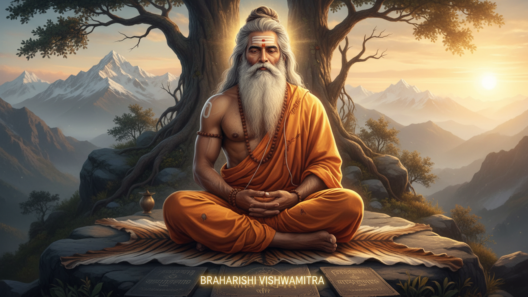


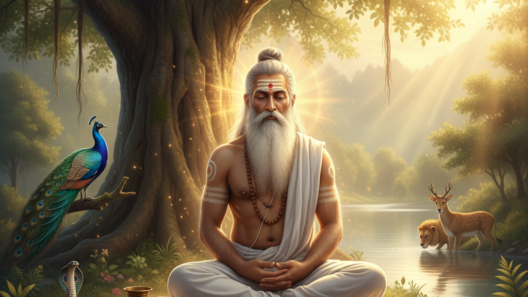
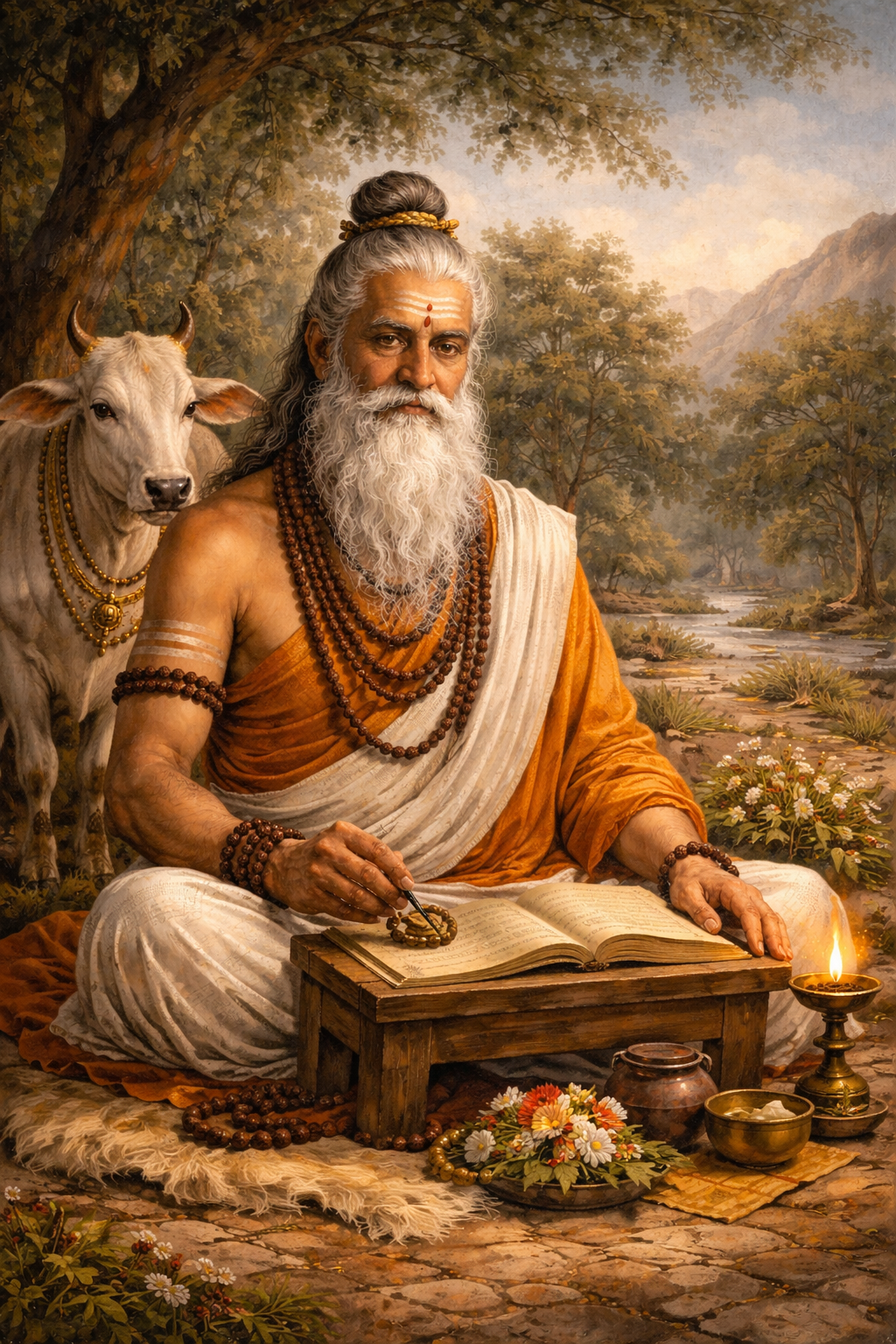
Maharishi Vashistha is revered as a Brahmarishi whose life and teachings represent the highest synthesis of knowledge, devotion, governance, and inner realization. He is remembered not only as a seer, but as a teacher of kings, guide of dynasties, master of non-dual wisdom, and the living embodiment of steady awareness.
If Maharishi Jamadagni represents disciplined fire and Maharishi Kashyapa represents compassionate creation, Maharishi Vashistha represents effortless wisdom—truth that remains unshaken in all circumstances.
The Cosmic and Spiritual Role of Maharishi Vashistha
Maharishi Vashistha occupies a stabilizing role in Sanatana Dharma:
He ensures that power remains subordinate to wisdom
He demonstrates inner freedom while living a full worldly life
He transmits Dharma through understanding, not fear
He teaches liberation without renunciation of responsibility
Vashistha stands as proof that the highest realization can coexist with family, duty, and leadership.
Meaning and Inner Significance of the Name “Vashistha”
The name Vashistha is traditionally interpreted as:
“The most excellent”
“One firmly established in supreme consciousness”
“One who has mastery over the mind and senses”
This mastery is not control through force, but natural authority born from clarity.
Vashistha as a Mind-Born Son of Brahma
According to tradition, Maharishi Vashistha is a Manasaputra (mind-born son) of Brahma, signifying that his wisdom arises directly from pure consciousness rather than acquired knowledge.
This origin establishes Vashistha as a sage whose understanding is:
Innate rather than learned
Stable rather than reactive
Universal rather than sectarian
Maharishi Vashistha and the Solar Dynasty
One of Vashistha’s most important roles was as the royal priest and spiritual guide of the Solar Dynasty (Suryavansha).
He guided generations of kings, including:
Ikshvaku
Dilipa
Raghu
Dasharatha
Through this role, Vashistha ensured that:
Governance remained aligned with Dharma
Power was tempered by compassion
Kings ruled as servants of righteousness
His influence shaped civilization itself, not just individuals.
Marriage to Arundhati: The Ideal of Sacred Partnership
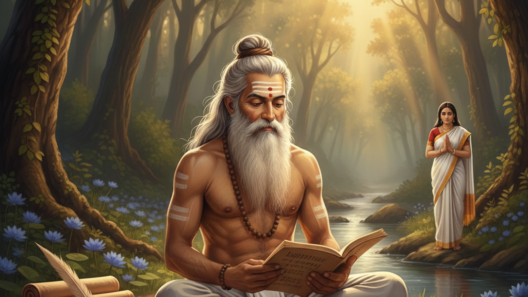
Maharishi Vashistha was married to Arundhati, who is revered as the eternal symbol of chastity, balance, loyalty, and spiritual equality.
Their relationship represents:
Mutual spiritual growth
Stability in worldly and inner life
Harmony between masculine and feminine wisdom
Even today, Arundhati–Vashistha are shown to newlyweds as the ideal couple, symbolizing that marriage itself can be a path of Dharma and realization.
Kamadhenu and the Symbol of Inner Abundance
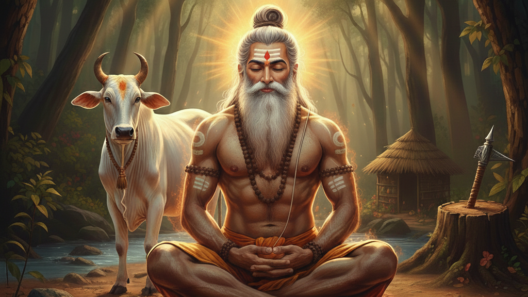
Maharishi Vashistha is closely associated with Kamadhenu, the divine cow.
Kamadhenu does not represent material wealth alone. She symbolizes:
Abundance that flows from wisdom
Needs fulfilled without greed
Prosperity aligned with Dharma
The episode involving Kamadhenu and Vishwamitra illustrates a profound truth:
Spiritual abundance cannot be seized by force; it arises naturally from inner realization.
Vashistha and Vishwamitra: Wisdom vs. Willpower
The interaction between Vashistha and Vishwamitra is one of the most philosophically rich narratives in Sanatana Dharma.
Where Vishwamitra pursued power through:
Austerity
Ego-driven ambition
Competition
Vashistha demonstrated:
Effortless authority
Inner stillness
Non-reactive wisdom
This contrast teaches that true spiritual power does not compete—it remains grounded and unshaken.
Ultimately, Vashistha’s presence becomes the catalyst for Vishwamitra’s transformation, showing that wisdom awakens others without confrontation.
The Yoga Vashistha: Scripture of Direct Liberation
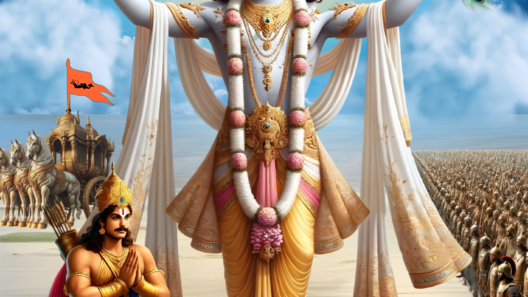
Maharishi Vashistha’s greatest contribution to humanity is the Yoga Vashistha, a monumental philosophical dialogue between Vashistha and Lord Rama.
This text teaches:
The illusory nature of suffering
Liberation through understanding rather than ritual
The mind as the source of bondage and freedom
The witnessing consciousness as true identity
Unlike many texts, Yoga Vashistha emphasizes:
Freedom here and now — not postponed to another life.
It is one of the most advanced expositions of non-dual awareness in Sanatana Dharma.
Vashistha as the Ideal Householder Sage
Unlike ascetics who withdrew from society, Vashistha lived fully as a householder, proving that:
Enlightenment does not require withdrawal
Responsibility refines awareness
Daily life itself can be spiritual practice
His life shows that wisdom matures through engagement, not escape.
Spiritual Significance: Living in Turiya
Maharishi Vashistha embodies Turiya—the fourth state of consciousness beyond waking, dreaming, and deep sleep.
He teaches that:
Liberation is a shift in perception
The mind becomes free when it recognizes its own nature
Life continues normally after realization
This insight is central to Natural Meditation.
Maharishi Vashistha and Natural Meditation
In the context of Natural Meditation, Vashistha represents effortless awareness.
The Vashistha Practice (Effortless Recognition)
When seeking peace:
Sit without trying to change experience
Rest as the awareness itself
This practice reveals:
Freedom is recognition, not effort.
Symbolism of Maharishi Vashistha
Calm demeanor – Unshakable inner mastery
Kamadhenu – Abundance rooted in wisdom
Teacher of Rama – Dharma transmitted through clarity
Arundhati – Sacred balance in partnership
Vashistha symbolizes wisdom that stabilizes the world.
Summary: The Living Legacy of Maharishi Vashistha
Maharishi Vashistha teaches that liberation does not require abandoning life — it requires understanding it clearly.
His legacy reminds humanity that:
Wisdom is natural
Peace is effortless
Life itself can be the path
His timeless truth is simple:
When awareness knows itself, freedom is immediate.